Tax Time

Corporate Tax Stress? Let’s Get It Handled.

Small business owners should not have to lose sleep over corporate tax returns, year-end financial statements, CRA notices, or overdue T2 filings.

If your Ontario corporation needs corporate tax work, Shlomo Podolsky CPA can help with:

Corporate tax is not just about filing a return. It is about making sure your year-end numbers are clean, your deadlines are understood, and your corporation is properly organized.

The CRA generally requires corporations to file their T2 corporation income tax return within six months after the end of the corporation’s tax year. Corporate tax balances may be due earlier, often two or three months after year-end depending on the corporation’s situation.

You can read the CRA’s information about when to file a corporation income tax return and the CRA’s page on important dates for corporations .

If your corporation is behind, disorganized, or simply ready for proper CPA-prepared year-end tax work, now is the time to deal with it.

Get the corporate tax work off your desk — and get back to running your business.

Call Shlomo Podolsky CPA: 416-856-8897
Email: [email protected]

Late corporate tax return? Penalties, deadlines & how to catch up

Missed Your Corporate Tax Deadline in Ontario? What Happens Next (And How to Fix It)

If you’ve missed your T2 corporate tax filing deadline, you’re not alone. Many Ontario business owners fall behind — especially when dealing with bookkeeping issues, multiple years of filings, or rapid business growth.

The important thing to understand is this: it’s fixable — but the longer you wait, the more it costs.

Business owner stressed about overdue corporate tax returns in Ontario
Behind on corporate tax returns?
See the full step-by-step catch-up process here: Catch Up on Overdue Corporate Tax Returns

What Happens If You Miss Your T2 Deadline?

In Canada, corporate tax returns (T2) are due 6 months after your fiscal year-end. If you miss that deadline, the CRA begins applying penalties immediately.

  • Late filing penalty: 5% of balance owing + 1% per month (up to 12 months)
  • Repeat offenders: penalties can double
  • Interest: compounds daily on unpaid taxes

Even if your corporation owes little or no tax, you are still required to file.

What If You’re Multiple Years Behind?

This is more common than you think.

Many business owners come in with:

  • 2–5 years of unfiled T2 returns
  • missing bookkeeping or incomplete records
  • CRA notices or compliance pressure

The key is not to panic — but to approach it systematically.

How to Catch Up (Properly)

Fixing overdue corporate tax filings isn’t about rushing — it’s about sequencing correctly.

  1. Identify all outstanding years
  2. Gather financial records (bank, credit cards, invoices)
  3. Prepare year-end financial statements
  4. File T2 returns in proper order
  5. Address CRA balances or payment plans

Done correctly, this minimizes penalties and reduces future risk.

Not sure if you need a CPA or a tax chain?
See our breakdown here: CPA vs H&R Block for Business Owners

Should You Wait or Fix It Now?

Waiting almost always makes things worse:

  • penalties grow
  • records become harder to reconstruct
  • CRA enforcement risk increases

The earlier you act, the more options you typically have.

When to Get Professional Help

If you’re dealing with:

  • multiple years outstanding
  • incomplete bookkeeping
  • CRA letters or notices

it’s usually worth getting structured help rather than trying to piece things together.

Need help catching up on corporate taxes?

We help Ontario corporations get back on track with T2 filings, financial statements, and CRA compliance.

Call: 416-856-8897
Email: [email protected]

Or request a consultation.

Podolsky Accounting
125 Theodore Place, Thornhill, Ontario, L4J 8E3
Serving Toronto, Vaughan, North York and all of Ontario

Behind on Corporate Tax Returns in Ontario? You’re Not Alone.

Behind on Corporate Tax Returns in Ontario? Here’s Exactly What to Do Next

If you’re behind on filing corporate tax returns, you’re not alone — and in most cases, it’s fixable with a clear plan.

Free guide for Ontario business owners
Download my plain-English guide: what happens when you’re late, what to gather, and the fastest path back to compliance.
Download the free tax guide

Behind on corporate taxes? You’re not the only one.

Falling behind on corporate filings happens more often than people think. It can come from a busy season, messy bookkeeping, cash flow stress, or simply not knowing where to start. The hardest part is usually the uncertainty — not the paperwork.

If you’re already behind, you may want to start with my free guide that explains the fastest, least stressful way to catch up on overdue corporate taxes.

The important thing to know is this: being behind is fixable. And in many cases, the sooner you start, the simpler and less expensive it becomes.

What can happen when corporate tax returns are filed late?

When corporate tax returns aren’t filed on time, a few things may continue in the background:

  • Late-filing penalties may apply
  • Interest can accrue on balances owing
  • CRA may send follow-up notices or requests
  • Financing, planning, and clean records become harder

For many business owners, the stress comes from not knowing what CRA will do next — or how much work is involved to catch up. With a clear plan, most situations become manageable quickly.

The biggest mistake people make when they’re behind

The most common mistake is waiting too long to act — not because people don’t care, but because they’re overwhelmed. Typical reasons:

  • You’re unsure how many years you’re behind
  • You don’t know what documents you’ll need
  • You assume the situation is worse than it really is

In reality, once we review what’s missing and what’s available, the “path forward” usually becomes clear. And clarity reduces stress immediately.

What you typically need to catch up (even if records are incomplete)

Before filings can be brought up to date, it helps to gather whatever you have from the years in question:

  • Bank and credit card statements
  • Bookkeeping files (QuickBooks, spreadsheets, etc.)
  • Prior tax filings (if any) and prior year financials
  • CRA notices and correspondence
  • Key receipts/invoices where available

Missing some records? That’s common. There are still practical ways to rebuild what’s needed so you can move forward.

Want the checklist + step-by-step plan?
I put everything into a short guide so you can stop guessing and start taking action.
Get the free guide

When should you speak to an accountant?

If you’re more than a year behind, a quick professional review can save time and prevent costly mistakes. The goal isn’t to “sell you” — it’s to get clarity on:

  • How far behind you are
  • What CRA is likely expecting next
  • The fastest and most efficient way to catch up

Once you have a plan, the stress usually drops right away.

If you haven’t already, start with the guide: https://shlomopodolsky.com/tax-guide/

Shlomo Podolsky, CPA — Helping Ontario business owners catch up on overdue corporate taxes and get back into compliance.

Corporate Tax Returns & Financial Statements for Corporations in North York, Toronto & Vaughan

Corporate Tax Returns & Financial Statements for Corporations in North York, Toronto & Vaughan

If you run an incorporated business in North York, Toronto, or Vaughan, filing accurate corporate tax returns (T2) and preparing reliable year-end financial statements is critical for CRA compliance and informed financial decisions.

Many corporate owners only think about taxes once the deadline approaches, but proactive corporate tax planning and properly prepared financial statements can significantly reduce risk, prevent penalties, and support better strategic planning.

Why Accurate Corporate Tax Returns Matter

Corporate tax returns are more than just a compliance requirement. They form the financial foundation for lender reviews, investor confidence, and CRA assessments. Poorly prepared filings can lead to reassessments, penalties, or delays when financing is needed.

For corporations operating in North York, Toronto, and Vaughan, ensuring that T2 filings align with year-end financial statements is especially important when dealing with growth, multiple revenue streams, or complex expense structures.

The Importance of CPA-Prepared Financial Statements

Year-end financial statements are often requested by banks, partners, and regulatory bodies. Professionally prepared statements provide clarity on profitability, cash flow, and retained earnings, helping corporate owners make informed decisions.

Accurate financial statements also ensure that corporate tax filings are consistent and supportable, reducing the likelihood of CRA scrutiny or unexpected reassessments.

Common Issues Corporations Face With T2 Filings

  • Late or missing corporate tax returns for prior years
  • Financial statements not aligned with tax filings
  • Inadequate documentation for expenses and deductions
  • CRA compliance concerns due to rapid business growth

Addressing these issues early can prevent compounding penalties and improve overall financial transparency for your corporation.

Corporate Tax Support for North York, Toronto & Vaughan Businesses

Corporations in North York, Toronto, and Vaughan often require specialized CPA support to ensure their T2 corporate tax returns and financial statements are prepared accurately and in compliance with CRA expectations.

If your corporation needs professional assistance with corporate tax filings and year-end financial statements, visit our dedicated service page:

When Should You Engage a CPA?

Ideally, corporate tax planning should begin before year-end, not after. Early planning allows for proper expense tracking, income timing strategies, and clearer financial reporting that supports both compliance and long-term growth.

Even if your corporation is behind on filings, a structured approach can bring multiple years of returns and financial statements up to date in a manageable and compliant manner.

Final Thoughts

For incorporated businesses in North York, Toronto, and Vaughan, corporate tax returns and financial statements are essential tools—not just regulatory requirements. Proper preparation ensures CRA compliance, supports financing opportunities, and gives business owners confidence in their financial position.

Salary vs. dividends

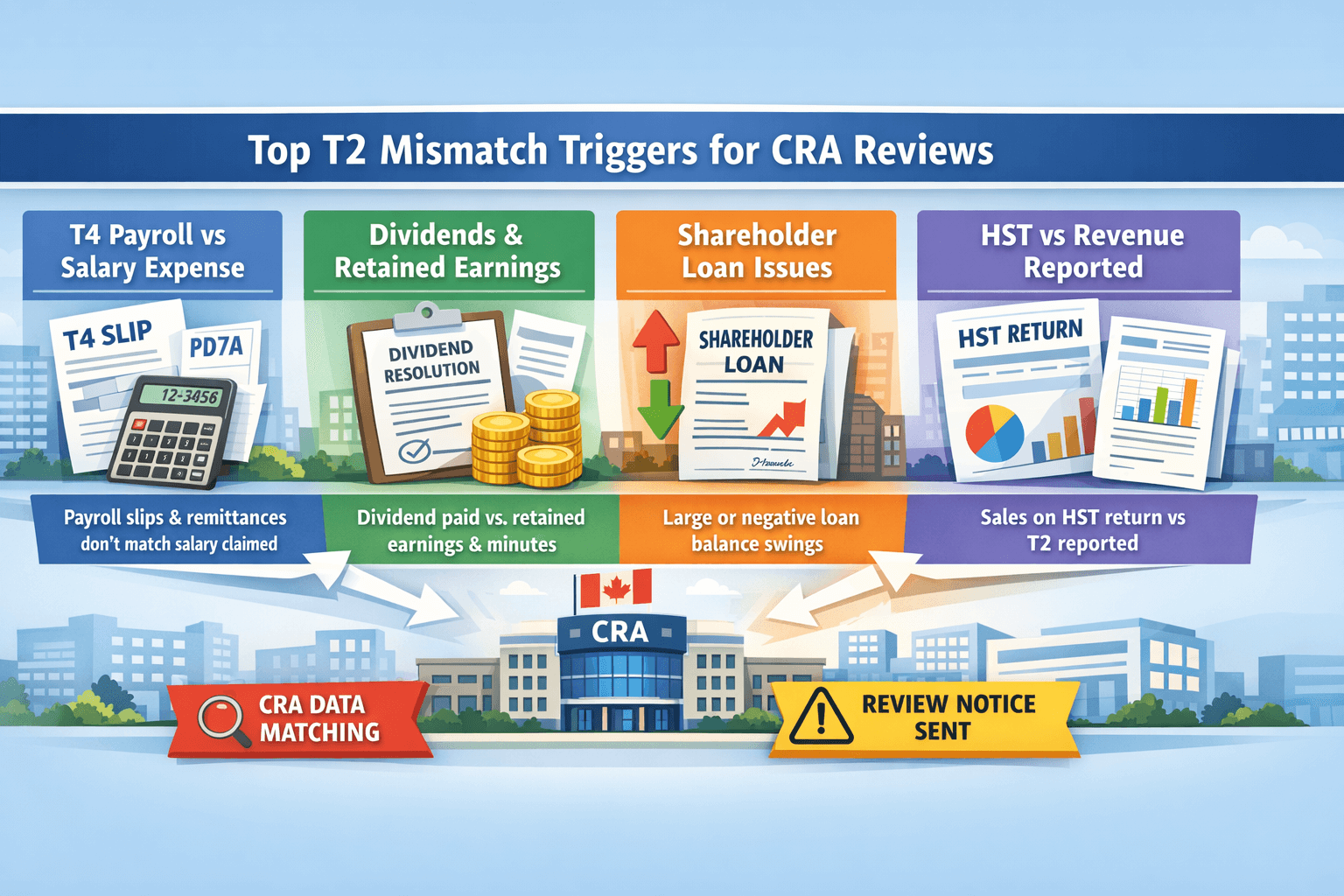
Panoramic infographic: top T2 mismatches that trigger CRA reviews for Ontario corporations
Panoramic snapshot: the mismatches CRA systems commonly flag (T2 vs payroll, slips, HST, and shareholder loan activity).

T2 Mismatch Risk: Why “Clean Books” Still Trigger CRA Reviews for Ontario Corporations

CRA corporate reviews often start because of mismatches—not obvious errors. Here are the most common T2 “matching” triggers and what to check before you file.

By Corporate Tax (T2)
Short on time?
If you want your year-end and T2 to line up cleanly (payroll, dividends, HST, shareholder loans), see T2 Corporate Tax Return Services or request a consultation. Prefer phone? Call 416-856-8897.

Why “Clean Books” Don’t Always Mean Low CRA Risk

Many Ontario corporations file a technically correct T2 and still get a CRA “matching” letter or review request. That’s because CRA doesn’t only assess your T2 in isolation—it cross-checks your filing against other data sources.

The result: small inconsistencies between your books, slips, payroll, HST, bank activity, and prior-year filings can trigger follow-up. These aren’t always “mistakes”—but they often require time-consuming reconciliation and supporting documents.

What CRA Often Cross-Checks Against Your T2

  • T4 payroll filings and remittances
  • T5/T4A slips (where applicable)
  • HST returns (for registrants)
  • Corporate bank activity and year-end cutoffs
  • Prior-year comparatives (swings in revenue/expenses/loans)

The Most Common T2 Mismatches That Trigger CRA Reviews

1) Salary expense vs T4/PD7A totals

A classic trigger: the corporation deducts salary on the T2 (or books), but the T4 slips and payroll reporting don’t reconcile cleanly. Even minor differences can cause CRA to ask for a reconciliation.

Common causes include year-end adjustments not reflected in payroll, last-minute bonuses, or bookkeeping/payroll handled in separate systems. (Related reading: Salary vs Dividends in Ontario.)

2) Dividends paid vs retained earnings and documentation

Dividend planning can be efficient—but it must be supported properly. CRA can request evidence of: director/shareholder resolutions, minutes, and that the corporation had sufficient retained earnings.

3) Shareholder loan fluctuations (due to/from shareholder)

Large swings, negative balances, or unusual year-end timing can prompt questions. The issue is often not the balance itself—it’s whether the story is consistent across your records and filings.

4) HST revenue vs financial statement/T2 revenue

CRA often compares revenue reported on HST returns versus revenue in your financial statements and T2. Timing differences can be valid, but unexplained mismatches can trigger follow-up.

A Practical Pre-Filing Alignment Checklist

Before filing your T2, it’s worth doing a quick alignment check:

  • Reconcile salary expense to T4 reporting and payroll remittances
  • Ensure dividends are documented (minutes/resolutions) and supported by retained earnings
  • Review shareholder loan movements for consistency and clear explanations
  • Compare HST revenue vs accounting revenue and document timing differences
  • Confirm that year-end financial statements and the T2 tell the same story

What This Means for Your Next Corporate Year-End

If your goal is simply to file quickly, you may still spend time later responding to CRA. If your goal is to file cleanly and defensibly, you want payroll, slips, HST, books, and T2 aligned before submission.

Related:

FAQ

Is getting a CRA review letter the same as an audit?

Not necessarily. Many corporate review letters are targeted “matching” requests for support and reconciliation. Still, they can take time and should be handled carefully.

Do I need to worry if my HST revenue doesn’t match my accounting revenue exactly?

Differences can be normal due to timing and reporting methods. The key is being able to explain and document the reason for any variance.

What’s the easiest way to reduce mismatch risk?

Align year-end financial statements, payroll/slips, and the T2 as one integrated process—rather than separate “tasks” done by different people.

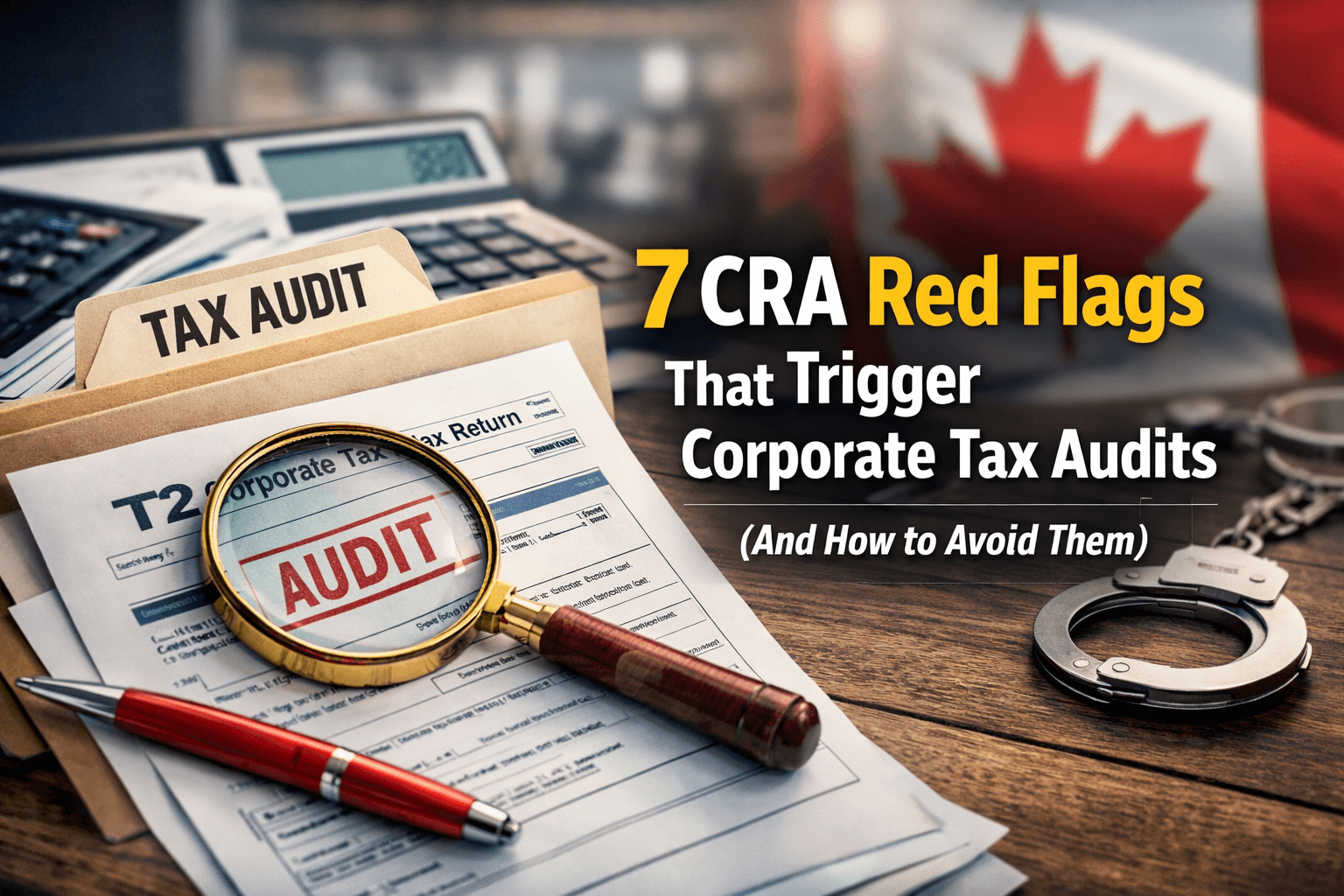
7 CRA Red Flags That Trigger Corporate Tax Audits (And How to Avoid Them)

CRA Corporate Tax Audit Red Flags for T2 Returns

7 CRA Red Flags That Trigger Corporate Tax Audits (And How to Avoid Them)

Corporate tax audits don’t happen randomly. In most cases, the CRA flags specific patterns on T2 corporate tax returns that indicate higher risk. If you own an incorporated business in Ontario, understanding these red flags can significantly reduce your audit exposure.

At Podolsky Accounting, we regularly assist corporations facing CRA reviews and audits — and the same issues appear repeatedly.


1. Shareholder Loan Accounts That Don’t Make Sense

One of the most common CRA audit triggers is an improperly reported shareholder loan balance. Overdrawn or uncleared shareholder loans can quickly lead to reassessments and taxable benefits.

CRA often focuses on:

  • Large year-end shareholder loan balances
  • Loans not repaid within the required time frame
  • Missing documentation or inconsistent reporting

2. High Expenses Relative to Revenue

Corporations reporting unusually high expenses compared to revenue frequently trigger CRA reviews. This is especially common in owner-managed small businesses.

CRA pays close attention to:

  • Vehicle and home office expenses
  • Meals and entertainment
  • Personal expenses run through the corporation

3. Inconsistent HST and T2 Reporting

If your HST filings don’t align with your T2 corporate tax return, the CRA’s systems will notice. HST mismatches are one of the fastest ways to trigger a desk audit.

This often happens when bookkeeping and tax filing are handled separately without professional review.


4. Repeated Losses Year After Year

Corporations that report losses consistently may be flagged to determine whether the business is truly commercial or partially personal in nature.

CRA may question:

  • Business intent and profitability
  • Expense deductibility
  • Whether the corporation is being used for tax deferral only

5. Late or Missing T2 Filings

Even inactive corporations must file a T2 return. Repeated late filings or missing returns significantly increase audit and penalty risk.

Professional corporate tax return services help prevent these issues entirely.


6. Aggressive Salary vs Dividend Splits

Improper compensation planning can raise CRA concerns, especially when dividends or salaries fluctuate without clear reasoning.

A CPA ensures compensation strategies are tax-efficient and defensible.


7. DIY Corporate Tax Filings

Self-prepared T2 returns often contain technical errors that trigger CRA follow-up. Unlike personal returns, corporate filings involve complex schedules that CRA reviews carefully.

If you’re unsure whether professional help is necessary, read: Do I Need an Accountant for My Small Business?


How a CPA Reduces CRA Audit Risk

At Podolsky Accounting, we don’t just file T2 returns — we prepare them with audit defense in mind. Our approach includes:

  • CRA-compliant reporting positions
  • Clean, supportable financial statements
  • Proper documentation and disclosures
  • CRA audit and review support if needed

We also provide audit and assurance services for corporations requiring higher-level reporting.


Concerned About CRA Audit Risk?

If your corporation is filing a T2 or has received CRA correspondence, working with an experienced CPA can make all the difference.

📞 Call 416-856-8897 or request a consultation online.

If you want these issues reviewed before CRA does, our corporate tax return services in Ontario help small business owners and corporations file accurate T2 returns with confidence.

Small Business T2 Corporate Tax Return: What Ontario Corporations Need to Know

Small Business T2 Corporate Tax Return Guide Ontario

Small Business T2 Corporate Tax Return: What Ontario Corporations Need to Know

If you operate a small business corporation in Ontario, filing your
T2 corporate tax return correctly is mandatory — even if your corporation
earned little or no income. Many business owners underestimate the complexity of T2 filings,
which often leads to CRA penalties, audits, or missed tax-saving opportunities.

This guide explains what Ontario small businesses need to know about T2 corporate tax returns
and when it makes sense to work with a CPA.


What Is a T2 Corporate Tax Return?

A T2 corporate tax return is the annual income tax return required for
all Canadian corporations. This includes:

  • Operating companies
  • Real estate holding corporations
  • Professional corporations
  • Investment and holding companies

Corporations must file a T2 every year, regardless of whether the business was active.

Learn more about professional

corporate tax return services in Ontario
.


When Is a T2 Corporate Tax Return Due?

A T2 return is due six months after your corporation’s fiscal year-end.
However, any corporate taxes owing are generally due
two or three months after year-end.

Late filing can result in:

  • Late-filing penalties
  • Daily interest charges
  • Increased CRA scrutiny

Common T2 Filing Mistakes Small Businesses Make

Some of the most common corporate tax issues we see include:

  • Incorrect shareholder loan balances
  • Improper expense deductions
  • HST not reconciling to financial statements
  • Failure to file for inactive corporations
  • Self-prepared T2 returns with technical errors

If you’re unsure whether professional help is necessary, read:

Do I Need an Accountant for My Small Business?


Why Use a CPA for Your Small Business T2?

A CPA ensures your corporate tax return is accurate, compliant, and optimized.
At Podolsky Accounting, we:

  • Prepare CRA-compliant T2 corporate tax returns
  • Review year-end financial statements
  • Identify legitimate tax planning opportunities
  • Provide CRA audit and review support

If your corporation requires higher-level reporting, we also offer

audit and assurance services
.


Serving Ontario Small Businesses

Podolsky Accounting serves corporations across Ontario, including Vaughan, North York,
Toronto, Mississauga, and surrounding areas. All services are available remotely,
making it easy to work with us from anywhere in Ontario.


Need Help Filing Your Small Business T2?

Work with a CPA who understands small business corporations and CRA compliance.
Podolsky Accounting provides reliable corporate tax return services across Ontario.

📞 Call 416-856-8897 or
request a consultation online.

2026 Strategic Planning for Ontario Small Corporations: Grow Smarter with Podolsky Accounting

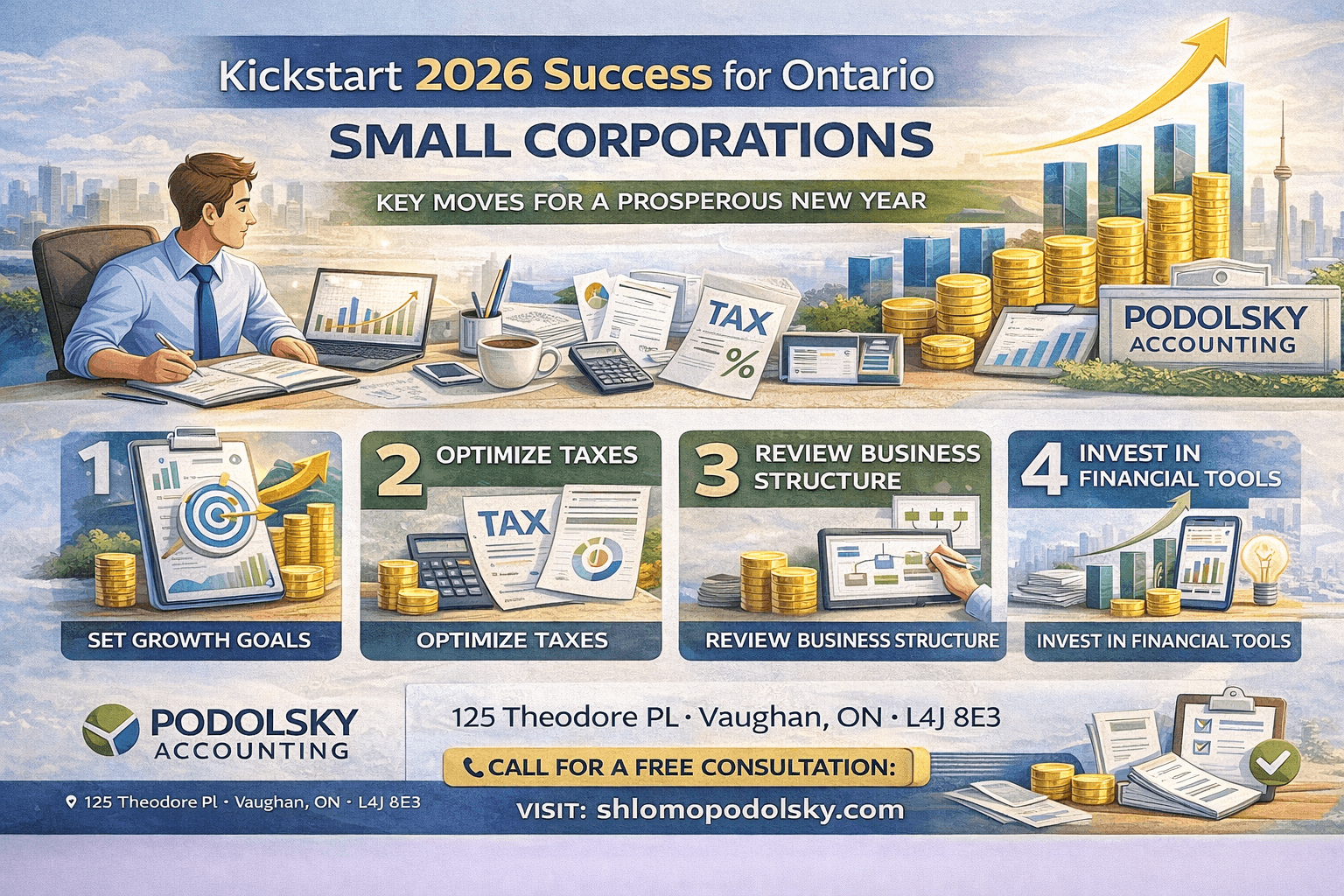
New Year Strategic Planning for Ontario Small Corporations 2026

2026 Strategic Planning for Ontario Small Corporations: Grow Smarter with Podolsky Accounting

New year, new opportunities! Small corporations in Ontario can maximize growth, streamline finances, and optimize taxes with a clear strategic plan. Podolsky Accounting helps business owners across Vaughan, Toronto, and the GTA achieve financial clarity and sustainable growth.

Why Small Corporations Need a 2026 Strategy

Many small businesses focus on day-to-day tasks but miss the big picture. Without planning:

  • Cash flow can become unpredictable
  • Tax advantages may be overlooked
  • Growth opportunities may slip away

Four Key Moves for a Prosperous New Year

1. Set Growth Goals

Define revenue and profit targets monthly, quarterly, and annually. This creates a roadmap for financial management and tax planning.

2. Optimize Taxes

Take advantage of corporate tax planning strategies, like T2 corporate tax optimization, to reduce taxable income and reinvest in your business.

3. Review Business Structure

Ensure your current incorporation model and shareholder agreements support your growth plans. Strategic restructuring can save taxes and improve flexibility.

4. Invest in Financial Tools

Use integrated bookkeeping, reporting, and payroll systems to monitor performance and make data-driven decisions. We provide expert support for small corporations across Ontario.

Internal Link – Boost Your Operations

Enhance your financial oversight with our Bookkeeping & Financial Statements services. Accurate records make strategic moves measurable and actionable.

External Link – Stay Updated

Keep informed on corporate tax changes and compliance with the CRA Corporate Tax Guidance.

Take Action Now

Kickstart 2026 with confidence. Combining a strategic plan with precise financial management sets your small corporation up for success.

Contact Podolsky Accounting Today

How Ontario Businesses Can Strengthen Financial Statements and Reduce CRA Risk

Ontario financial statements and CRA compliance infographic

How Ontario Businesses Can Strengthen Financial Statements and Reduce CRA Risk

Accurate financial statements are more than just numbers on a page — they are a critical foundation for tax compliance, financing approval, and long-term business growth. For Ontario business owners, weak or inconsistent financial reporting is one of the most common reasons for CRA reviews, reassessments, and rejected financing applications.

In this guide, we explain how professionally prepared financial statements protect your business, improve credibility, and support smarter tax outcomes.


Why Financial Statements Matter More Than Ever

Whether you operate a corporation in Vaughan, Toronto, Mississauga, or anywhere in Ontario, your financial statements are relied on by:

  • The Canada Revenue Agency (CRA)
  • Banks and private lenders
  • Investors and potential buyers
  • Business partners and shareholders

Poor documentation, missing schedules, or inconsistent bookkeeping often leads to CRA scrutiny — even when no wrongdoing exists.

Common Financial Statement Mistakes That Trigger CRA Attention

  • Mismatched revenue between T2 returns and bookkeeping
  • Unsupported expense claims
  • Shareholder loan imbalances
  • HST filings that don’t reconcile to income
  • Year-end adjustments done incorrectly or not at all

These issues are preventable with proper year-end preparation.

How Professional Financial Statements Protect Your Business

At Podolsky Accounting, we prepare financial statements that are:

  • CRA-compliant
  • Aligned with your corporate tax return (T2)
  • Suitable for lenders and investors
  • Structured for long-term tax planning

When done correctly, financial statements don’t just report history — they help shape better decisions.

Internal Link: Related Services

If your financial statements support a corporate tax filing, you may also want to review our:

👉 Corporate Tax Return (T2) Services in Ontario

External Authority: CRA Guidance

For official CRA requirements regarding business records and financial reporting, see:

🔗 CRA – Keeping Business Records

Local Ontario Expertise Makes the Difference

Ontario businesses face unique compliance expectations. Working with a CPA who understands local CRA practices, lender standards, and corporate structures ensures your reporting stands up to scrutiny.

We provide remote support across Ontario, including:

  • Vaughan
  • Toronto
  • Mississauga
  • Oakville
  • Richmond Hill

Final Thoughts

Strong financial statements reduce risk, unlock financing, and give you confidence when dealing with CRA. If your records aren’t telling the full story — or worse, telling the wrong one — it’s time to fix that.

Good accounting isn’t an expense. It’s protection.

“Why Accurate Financial Statements Are Essential for Ontario Businesses”

Accounting and financial statement services for Ontario businesses

Why Accurate Financial Statements Are Essential for Ontario Businesses

Accurate financial statements are the backbone of a successful business. For small and mid-sized Ontario businesses, reliable records are crucial for tax compliance, securing financing, and building investor trust.

At Podolsky Accounting, we help business owners maintain financial statements that are precise, well-documented, and ready for any review or audit.

The Importance of Clean Financial Records

Clean financial records prevent costly mistakes and misunderstandings. Poorly maintained books can lead to:

  • Errors in reporting revenues and expenses
  • Increased risk of CRA audits
  • Delays in securing loans or attracting investors
  • Higher professional fees to correct mistakes

Integrated Bookkeeping & Financial Statement Services

Our Bookkeeping & Financial Statement Services ensure monthly bookkeeping feeds seamlessly into your year-end financial statements. This reduces errors, saves time, and gives you confidence in every report.

Preparing for Lender or CRA Review

Financial statements are often reviewed by banks, investors, and the CRA. Accurate reports mean:

  • Smoother and faster loan applications
  • Audits that are simpler and less stressful
  • Business decisions based on reliable data

For official guidance on maintaining business records, see the CRA site:

CRA – Keeping Records for Your Business

Conclusion

Investing in proper accounting isn’t just about compliance — it’s about building a stronger, smarter business. With clean financial statements, you can make confident decisions, stay compliant, and grow with assurance.

Contact a CPA Today

How Proper Financial Records Reduce Audit Risk for Ontario Businesses

Audit and financial review for Ontario business accounting services

How Proper Financial Records Reduce Audit Risk for Ontario Businesses

Maintaining accurate financial records is one of the most effective ways to reduce the risk of audits, CRA reassessments, and costly adjustments. When books are organized and reconciled regularly, there’s less stress, fewer surprises, and stronger confidence from lenders, partners, and regulators.

At Podolsky Accounting, we help Ontario businesses ensure their financial reporting is not only compliant but strategically useful for growth and decision-making.

Common Causes of Audit Triggers in Ontario

Audits are often initiated because of issues such as:

  • Unreconciled accounts
  • Discrepancies in reported income
  • Unsupported deductions
  • Missing source documentation

When records are incomplete or inconsistent, auditors — whether CRA or lenders — have to dig deeper, increasing your audit exposure and time spent.

How Professional Bookkeeping Improves Audit Outcomes

Accurate monthly bookkeeping provides a clear financial trail that supports year-end statements and audit verification. Key benefits include:

  • Improved accuracy of financial statements
  • Faster audit procedures
  • Reduced risk of penalties
  • Better decision-making data for management

Our Bookkeeping & Financial Statement services ensure your records are audit-ready year-round.

When Audits Are Required

Certain situations commonly require formal audits, such as:

  • Lender or bank financing requirements
  • Investor or shareholder agreements
  • Partnership reporting obligations
  • Regulatory or CRA compliance checks

Our Audit Services in Ontario provide comprehensive audit support, preparing your business for whatever level of scrutiny is needed.

What the CRA Expects From Record-Keepers

The Canada Revenue Agency (CRA) expects businesses to maintain complete and accurate books, including:

  • Bank and credit card reconciliations
  • Payroll records
  • Sales and HST-GST documentation
  • Supporting receipts and invoices

For the official CRA guidance on keeping records for tax purposes, visit:

Canada Revenue Agency – Keeping Records for Your Business

Final Thought

Strong bookkeeping isn’t just good practice — it’s a competitive advantage. When your records are accurate, your business is better positioned for audits, financing, and growth.

Speak With a CPA

Elementor #2655

Don't take advice wearing a blindfold
Why Canadian Business Owners Need a CPA — Not Just AI Tools Like Grok

Why Following AI Alone Can Put Canadian Business Owners at Serious Tax Risk

Artificial intelligence tools like Grok are becoming increasingly popular among Canadian business owners looking for quick answers to tax questions. While AI can summarize tax rules, relying on it alone for corporate tax compliance is one of the fastest ways to expose your business to CRA penalties, audits, and non-deductible interest.

Filing a Canadian corporate tax return is not an information problem. It is a judgment, compliance, and risk-management problem — one that requires CPA expertise.

The Reality of Filing a Canadian T2 Corporate Tax Return

A T2 corporate tax return is a legally binding filing that requires accuracy, consistency, and defensibility. Unlike personal tax returns, corporate filings involve:

  • Income classification and timing differences
  • Industry-specific tax rules
  • Detailed schedules and disclosures
  • Integration with sales tax filings
  • CRA audit exposure

AI tools can explain how a rule works in theory. A CPA determines whether applying that rule in your specific situation creates unnecessary risk.

That distinction matters when CRA reviews your return.

Learn more about professional CPA-prepared filings here:
Canadian Corporate Tax Returns (T2) – Podolsky Accounting

Sales Tax Across Provinces: Where AI Advice Fails Most Often

Sales tax compliance is one of the most common areas where AI-generated advice leads to costly errors. Canada does not have a single sales tax system.

Depending on your business, you may need to comply with:

  • GST (federal)
  • HST (harmonized provinces)
  • PST (British Columbia, Saskatchewan, Manitoba)
  • QST (Quebec)
  • Inter

Stay in your lane and get professional help.

Corporate Tax Filing Guidance

Corporate Tax Filing Made Simple: Expert CPA Guidance in the GTA

Running a business is demanding — especially when deadlines, CRA regulations, and corporate tax filings are added to your to-do list. At Shlomo Podolsky Accounting, we believe your financial peace of mind starts with clarity, expertise, and reliable support.

In this blog post, we’ll explain why professional corporate tax support matters, how you gain strategic benefits beyond compliance, and how our services are designed to support businesses like yours.

Why Corporate Tax Filing Shouldn’t Be an Afterthought

Every incorporated business operating in Canada must file a T2 corporate tax return with the Canada Revenue Agency (CRA). Many business owners underestimate the complexity and risk of the process:

  • Multiple schedules, deductions, and credits
  • CRA compliance requirements
  • Penalties for late or incorrect filings
  • Missed opportunities for tax planning

That’s where expert support matters most.

How We Help You Win with Your Taxes

1. Accurate, Timely T2 Corporate Tax Returns

Corporate tax filings have big consequences. Filing on time — and filing right — means no penalties, no surprises, and a clean compliance record with CRA. Our process ensures:

  • Expert preparation
  • Detailed accuracy
  • Filings submitted before deadlines
  • Seamless handling of adjustments and credits

2. Tailored Tax Strategies That Save You Money

Every business is unique. We go beyond compliance to optimize your tax position through:

  • Identification of deductions and credits
  • Planning for tax season throughout the year
  • Personalized strategies that fit your industry

3. Clarity and Support You Can Rely On

For many business owners, the hardest part isn’t the numbers — it’s not knowing where to start. We break down complicated tax concepts into clear explanations, provide regular updates, and make accounting support accessible when you need it most.

If you want reliable monthly bookkeeping and clear financial reporting alongside your corporate tax support, visit our Bookkeeping & Financial Statements page to see how we help Ontario businesses keep their finances organized and compliant.

Why Local Expertise Matters

Whether you’re in Oakville, Vaughan, or anywhere in the GTA, local knowledge is a huge advantage. We understand:

  • Regional business nuances
  • Local CRA practices
  • What growing businesses typically overlook

Being close to our clients means you don’t just get a CPA — you get a financial partner invested in your success.

Your Business Deserves Strategic Accounting Support

From corporate tax returns to bookkeeping, financial statements, and strategic tax planning, we have you covered — year-round. Let us handle the numbers so you can focus on growing your business.

For official guidance on corporate tax filing, visit the Canada Revenue Agency (CRA).

Contact Us Today

Tips for Business Owners: What to Prepare Before Tax Filing

  • Financial statements and year-end reports
  • Records of expenses and revenue streams
  • Payroll and HST/GST documents
  • Prior year filings and notices from CRA

Final Thought

A strong CPA doesn’t just file your forms — they help you build a smarter, more resilient business. That’s the value we deliver at Shlomo Podolsky Accounting.

Do I need an audit or a review engagement?

Audit vs. Review Engagement: Key Differences Every Ontario Business Should Know

When lenders, investors, or shareholders request financial statements, many Ontario business owners are unsure whether they need an Audit or a Review Engagement. Both are assurance services performed by a CPA, but they differ significantly in assurance level, procedures performed, time commitment, and cost.

This guide clearly explains the differences so you can choose the right option for your corporation or small business.

What Is an Audit?

An Audit provides the highest level of assurance. The objective is to determine whether the financial statements are free from material misstatement.

Audit procedures typically include:

  • Detailed testing of transactions
  • Third-party confirmations from banks, suppliers, and customers
  • Review of internal controls
  • Fraud risk assessment
  • Substantive testing and analytical procedures

Upon completion, the CPA issues an Audit Opinion, which lenders and investors often require for significant financing or complex operations.

When You May Need an Audit

  • Significant commercial loans or refinancing
  • Investor requirements
  • Regulated industries
  • Charities and nonprofits receiving grants
  • Businesses with multiple shareholders

What Is a Review Engagement?

A Review Engagement offers moderate assurance. It is more detailed than a compilation but less intensive than an audit.

Review procedures include:

  • Analytical procedures
  • Financial ratio analysis
  • Discussion and inquiries with management

The CPA issues a Review Engagement Report stating the financial statements are “plausible.”

When You May Need a Review

  • Small to medium bank loans
  • Lender requests for limited assurance
  • Internal company planning
  • Businesses wanting credibility at lower cost than an audit

Audit vs. Review: Side-by-Side Comparison

Feature Audit Review Engagement
Level of Assurance High Moderate
Procedures Performed Testing, verification, confirmations Analytics and inquiries only
Cost Higher Lower
Time Required Longer Shorter
Common Users Banks, investors, regulators Banks, owners, management

Audit & Review Engagement Services in Ontario

At PodolskyAccounting, we provide full-service assurance engagements across Ontario. Related services include:

Serving clients in Vaughan, Toronto, Richmond Hill, Markham, Mississauga, Oakville, and all of Ontario—both remotely and in person.

Book a free consultation today.

Frequently Asked Questions

Is a review engagement enough for a bank loan?

Yes, for most small to mid-sized loans. Larger financing may require an audit.

Which costs more: an audit or a review?

An audit costs more due to detailed testing and verification.

Does every Ontario corporation need an audit?

No. Most private corporations do not require one unless shareholders or lenders ask for it.

Can a review be upgraded to an audit later?

Yes. A CPA can expand a review engagement into a full audit if needed.

Your filing deadlines – mapped out for you

What Tax Deadlines Should CCPC Owners Be Aware Of?

Your complete Ontario corporate tax deadline guide — ready for action.

Author: Shlomo Podolsky • Updated:

Running a Canadian-Controlled Private Corporation (CCPC) gives you tax advantages, but it also brings strict filing and payment deadlines. Missing a deadline can mean penalties, interest, or unwanted CRA attention. This guide explains the deadlines every CCPC owner in Ontario (and across Canada) must track.

1. Your corporate year-end sets all deadlines

Your CCPC’s deadlines are based on the fiscal year-end you choose (not the calendar year). Many small corporations use December 31, but you can choose any date. Once your year-end passes:

  • File the T2 within 6 months of year-end.
  • Pay taxes within 2–3 months of year-end (see below).
  • Make instalments during the year if required.

Internal link suggestion: Learn how year-end planning can reduce CCPC tax.

2. T2 corporate tax return deadline

Due: 6 months after your year-end.

Examples:

  • Dec 31 year-end → June 30 filing deadline
  • Mar 31 year-end → Sept 30 filing deadline

3. Corporate tax payment deadline (2–3 months)

The payment deadline differs from the filing deadline:

  • 3 months after year-end — if the CCPC qualifies for the Small Business Deduction.
  • 2 months after year-end — if it does not qualify.

CRA charges interest on unpaid taxes starting the day after the payment deadline.

4. GST/HST filing and payment

Deadlines depend on reporting frequency:

  • Annual filers: 3 months after year-end
  • Quarterly filers: 1 month after quarter-end
  • Monthly filers: 1 month after month-end

Note: instalments are still required when applicable, even for annual filers.

5. Payroll: T4 slips & remittances

If you pay salaries (including paying yourself a salary):

  • T4 slips & T4 Summary: due February 28.
  • Payroll remittances:
    • Monthly filers — due the 15th of the month
    • Quarterly filers — due 1 month after the quarter
    • Accelerated filers — 3–5 days after pay date (large employers)

6. Dividends: T5 slips

If your CCPC issues dividends you must file T5 slips and a T5 Summary by February 28.

7. WSIB & EHT (Ontario employers)

  • Employer Health Tax (EHT) — annual return due March 15. Monthly instalments may be required if payroll is above the exemption.
  • WSIB — premiums typically due the 20th of the month following the reporting period; annual reconciliation due in March–April.

8. Corporate instalments

If your corporation owed more than $3,000 in tax last year, CRA expects instalments during the year.

  • Usually monthly, sometimes quarterly.
  • Interest applies to missed instalments even if you pay the year-end balance later.

9. Shareholder loan repayment deadline (Section 15(2))

If you or a shareholder took a loan from the corporation, it generally must be repaid within one year after the end of the tax year in which the loan was made — otherwise it may be included in the shareholder’s income.

Example: Loan taken July 2025 with Dec 31, 2025 year-end → repay by Dec 31, 2026.

Quick CCPC tax deadlines — at a glance

Obligation Deadline
T2 Corporate tax return 6 months after year-end
Corporate tax payment 2–3 months after year-end
GST/HST filing 1–3 months depending on frequency
T4 slips & summary February 28
T5 slips & summary February 28
Payroll remittances 15th monthly / quarterly / accelerated
EHT (Ontario) March 15
WSIB premiums 20th of the following month
Shareholder loan repayment 1 year after the relevant year-end

Need help staying compliant?

Managing deadlines while running a business is time-consuming. I help CCPC owners across Ontario — including Toronto, Vaughan, Woodbridge, Oakville — with:

  • Corporate tax filing & planning
  • GST/HST returns & instalments
  • Payroll setup, T4/T5 preparation
  • Dividend vs salary planning
  • CRA correspondence & audit support

Ready for assistance? Book a consultation or email me at [email protected].

How to Choose a Reliable CPA in Toronto for Tax Filing


How to Choose a Reliable CPA in Toronto for Tax Filing

Filing taxes in Toronto can be complicated, and choosing the right CPA (Certified Professional Accountant) is crucial to ensure accuracy, maximize deductions, and stay compliant with CRA regulations. Here’s a guide to help you select a reliable CPA for your tax filing needs.

1. Check Credentials and Experience

The first step is verifying that your CPA is fully certified in Ontario. Look for credentials such as CPA, CA, CGA, or CMA, which indicate proper training and licensing. Experience matters too—CPAs who have handled clients in your industry or tax situation are more likely to optimize your returns and avoid errors.

2. Evaluate Their Specializations

Some CPAs specialize in corporate tax, small business, personal tax, or cross-border filings. Make sure your CPA has expertise relevant to your needs. For example:

  • Small business owners: may need advice on corporate tax planning and deductions.
  • Individuals with investments: may require guidance on capital gains and tax-efficient strategies.
  • New immigrants: may need help with foreign income reporting and CRA credits.

3. Read Reviews and Ask for References

Reputation is key. Check online reviews, testimonials, or ask your CPA for references from past clients. Reliable CPAs should be transparent and willing to provide examples of their work while respecting client confidentiality.

4. Understand Fees and Billing Structure

CPAs may charge hourly, flat fees, or retainer packages. Before hiring, clarify the costs and what services are included. Remember, the cheapest option is not always the best—accuracy and compliance are worth paying for.

5. Look for Clear Communication

A good CPA explains complex tax concepts in simple terms and responds promptly to your questions. If your CPA is hard to reach or uses confusing jargon, it may lead to misunderstandings and mistakes in your filings.

6. Consider Accessibility and Technology

Many Toronto CPAs offer online portals, secure document sharing, and virtual consultations. This can save you time and make tax filing more efficient, especially during peak season.

7. Trust Your Instincts

Finally, trust your gut. A CPA is not just a tax filer—they are your financial advisor. Choose someone you feel comfortable with, confident in their expertise, and confident they will protect your interests.

Conclusion

Finding a reliable CPA in Toronto doesn’t have to be overwhelming. Focus on credentials, experience, reviews, fees, and communication style. With the right CPA by your side, you can simplify your tax filing, maximize deductions, and ensure compliance with CRA rules.

Looking for professional CPA services in Toronto? Contact us today for a consultation.

Learn more about corporate tax planning in Toronto.

For incorporated business owners, choosing between salary and dividends can significantly impact tax outcomes.